
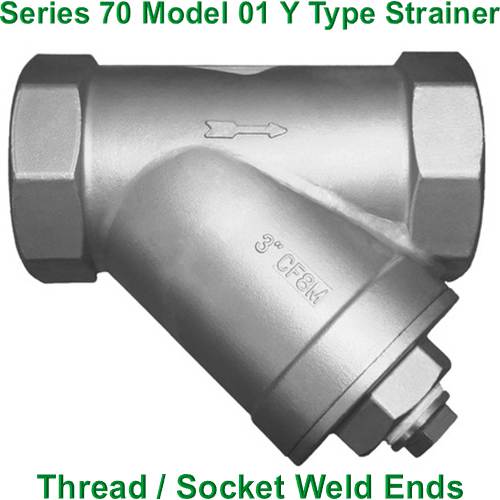
 Series 70 Model 01 Y Type Strainer
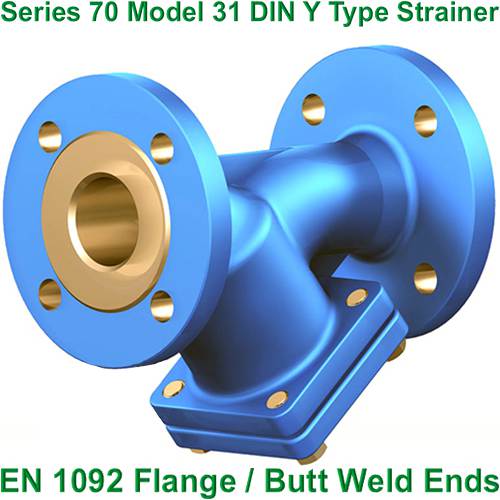 Series 70 Model 31 DIN Y Type Strainer
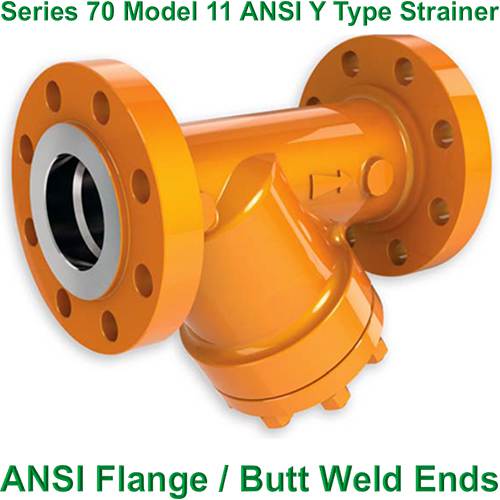 Series 70 Model 11 ANSI Y Type Strainer
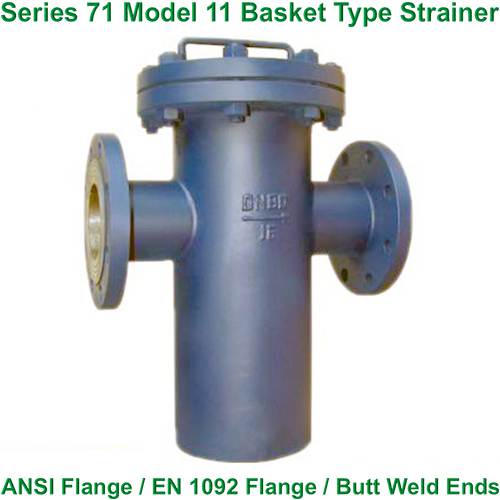 Series 71 Model 11 Basket Type Strainer
Advantages, Disadvantages, and Main Application Areas of
Y-type Strainer, Basket-type Strainer, Cone-type Strainer, and T-type Strainer
1. Brief Description:
1.1 Y-Type Strainer: Extremely low flow resistance, compact structure, and easy maintenance;
1.2 Basket-Type Strainer: Large basket volume, can hold a large amount of impurities, and can be maintained without shutting down the system;
1.3 Cone-Type Strainer: Mostly used for temporary installation, commonly used before project startup, hence also known as a temporary filter;
1.4 T-Type Strainer: Commonly used for coarser filtration, capable of handling higher pressures and flow rates.
2. Advantages, Disadvantages, and Applicable Operating Conditions of Different Types of Strainers:
2.11 Advantages of Y-Type Strainers:
① Small size and flexible installation; can be installed horizontally or vertically, even in narrow pipe locations;
② Simple structure, low cost, easy disassembly and maintenance, and convenient drainage;
③ Moderate flow resistance, low pressure loss for conventional clean media;
④ Wide pressure rating coverage, with corresponding specifications for normal pressure, medium-pressure, and high-pressure operating conditions.
2.12 Disadvantages of Y-Type Strainers:
① Very small impurity capacity of the filter screen, easily clogged, unsuitable for media with high impurity content;
② Poor manufacturing economy for large-diameter specifications; rarely used for sizes above DN200;
③ Filter screen subjected to oblique force; prone to deformation and damage under high pressure and high flow conditions;
④ High maintenance workload under frequent drainage conditions.
2.13 Main Application Areas of Y-Type Strainers:
① Water supply and drainage, HVAC circulating water, gas pipelines, compressed air pipelines;
② Small protective filters before valves and pumps (stop valves, solenoid valves, pre-protection for small water pumps);
③ Clean oil products in petroleum refining, steam pipelines, heat transfer oil pipelines;
④ Clean process media in chemical industry, fire protection pipelines, central air conditioning systems;
⑤ Pipe diameter range: DN15~DN200.
2.21 Advantages of Basket-Type Strainers
① Large filter basket volume, extremely strong dirt-holding capacity, can operate for a long time without cleaning;
② Supports large diameter and high flow conditions (DN25~DN1200 can be manufactured);
③ Can be made with a quick-opening structure, cleaning the filter basket can be completed in minutes by opening the cover, some can be equipped with a bypass to achieve non-stop cleaning;
④ The filter screen is subjected to uniform stress, not easily damaged under high pressure and high flow rate;
⑤ Can be equipped with multi-layer filter screens and magnetic filter screens, suitable for viscous media.
2.22 Disadvantages of Basket Type Strainers
① Large overall size, occupies a lot of space, and cannot be installed in narrow pipe corridors
② Cost is much higher than Y-type filters;
③ Sludge easily accumulates at the bottom when installed vertically, and viscous media tend to accumulate and clump;
④ Uneconomical for small pipe diameters.
2.23 Main Application Areas of Basket Type Strainers
① Chemical raw materials, wastewater treatment, large-diameter circulating water pipelines;
② Crude oil, heavy oil, slurry, and industrial fluids with high impurity content;
③ Power plant circulating water, water treatment systems, and front-end filtration for wastewater treatment pump stations;
④ Coal chemical industry, chemical fiber slurry, coatings, and viscous liquid filtration;
⑤ Main pre-filter for large pump sets and heat exchangers.
2.31 Advantages of Cone Type Strainers
① Extremely simple structure and extremely low cost, basically only a conical filter screen + gasket;
② Easy installation, simply clamped between two flanges;
③ Thin thickness, occupying almost no axial pipe space.
2.32 Disadvantages of Cone Type Strainers
① Only suitable for temporary filtration; extremely small dirt-holding capacity, prone to clogging, and cannot operate continuously for extended periods;
② Lacks a dedicated drainage structure; after clogging, the flange must be disassembled for cleaning;
③ Weak pressure resistance; the filter screen is easily damaged under high-pressure conditions;
④ Can only perform coarse filtration, not fine filtration.
2.33 Main Applications of Cone Type Strainers
① Temporary filtration during pipeline purging, system pressure testing, and plant start-up;
② Protection of pumps, instruments, and valves during the initial commissioning of new plants; removed after operation is complete;
③ Temporary interception of welding slag, sand, and rust during trial operation after clean pipeline maintenance;
④ Rarely used as permanent filtration equipment.
4.41 Advantages of T-Type Strainer
① Straight and smooth flow channel, extremely low fluid resistance, and minimal pressure loss;
② Horizontally arranged filter screen, impurities settle in the lower collection chamber, reducing the risk of filter screen erosion;
③ Can be equipped with a bottom drain port for continuous production without shutting down the system;
④ Better stability under large-diameter, high-pressure conditions than Y-type;
⑤ Good adaptability for horizontal pipeline installation.
2.42 Disadvantages of T-Type Strainer
① More complex structure and higher price than Y-type;
② Larger lateral dimensions, inconvenient for installation in narrow vertical pipelines;
③ Dirt holding capacity is between Y-type and basket strainer, less durable than basket strainer.
2.43 Main Application Areas of T-Type Strainer
① Oil refining, long-distance natural gas pipelines, high-pressure process pipelines;
② Clean fluid transportation in fine chemicals, pharmaceuticals, and food;
③ High-pressure steam, high-pressure water systems, compressor front-end filtration;
④ Continuous production lines with strict pressure drop requirements and inability to frequently shut down;
⑤ Media sensitive to pressure loss, such as oils and solvents.
3. Selection Recommendations:
3.1 For small-diameter pipes, clean media, and protective valves/pumps, a Y-type Strainer is recommended.
3.2 For small-diameter instrument pressure lines, a Y-type Strainer is recommended.
3.3 For steam systems with small pipe diameters, a Y-type Strainer is recommended.
3.4 For high-flow-rate systems with many impurities and long-term continuous operation, a Basket-type Strainer is recommended.
3.5 For viscous chemical slurries and wastewater, a Basket-type Strainer is recommended.
3.6 For viscous media containing a large number of solid particles, a Basket-type Strainer is recommended.
3.7 For start-up purging, temporary protection, and dismantling after use, a Cone-type Strainer is recommended.
3.8 For pressure testing and purging of newly constructed pipelines, a Cone-type Strainer is recommended.
3.9 For high-pressure pipelines, media sensitive to pressure drop, and where frequent shutdowns are not possible, a T-type Strainer is recommended.
3.10 For large-diameter main steam pipelines, a T-type Strainer is recommended.