
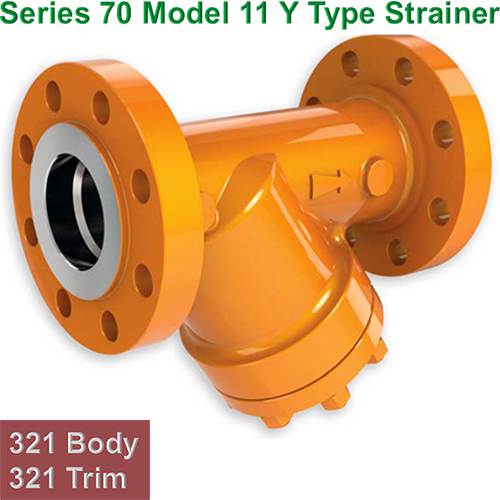
Features and applications of stainless steel 321 ANSI Y-type strainer produced by Freeman Valve
1. Basic characteristics of stainless steel 321 ANSI Y-type strainer:
321 stainless steel is an austenitic stainless steel (nominal composition: 18% Cr, 10% Ni, Ti≥5×C%) with titanium (Ti) added as a stabilizing element on the basis of 304 stainless steel. The addition of titanium effectively inhibits the precipitation of chromium carbide at the grain boundary, thereby significantly improving the resistance to intergranular corrosion. Freeman Valve is a manufacturer of stainless steel 321 ANSI Y-type strainer.
2. The main advantages of stainless steel 321 ANSI Y-type strainer produced by Freeman Valve:
2.1 The stainless steel 321 ANSI Y-type strainer produced by Freeman Valve has good resistance to intergranular corrosion:
Titanium and carbon preferentially combine to form TiC, avoiding the precipitation of Cr23C6 in the sensitization temperature range (450-850℃), which is suitable for welding or high temperature environment.
2.2 The stainless steel 321 ANSI Y-type strainer produced by Freeman Valve has excellent high temperature resistance:
The stainless steel 321 ANSI Y-type strainer produced by Freeman Valve can work stably for a long time below 800℃ (short-term resistance to 900℃), and the oxidation resistance is better than 304, which is suitable for thermal cycle conditions.
2.3 The stainless steel 321 ANSI Y-type strainer produced by Freeman Valve has good processing and weldability:
a. The austenitic structure gives the stainless steel 321 ANSI Y-type strainer high ductility and easy cold forming;
b. The stainless steel 321 ANSI Y-type strainer do not need annealing after welding (but the interlayer temperature needs to be controlled).
2.4 The stainless steel 321 ANSI Y-type strainer produced by Freeman Valve has good comprehensive corrosion resistance:
The stainless steel 321 ANSI Y-type strainer produced by Freeman Valve is resistant to atmospheric corrosion, weak acid corrosion, alkali corrosion and organic medium corrosion, and their performance is equivalent to 304.
3. The following issues should be noted when using stainless steel 321 ANSI Y-type strainer:
3.1 The mechanical strength of stainless steel 321 ANSI Y-type strainer is relatively low: the annealed yield strength of 321 stainless steel is about 205MPa, and it needs to be strengthened by cold working (but it will reduce corrosion resistance);
3.2 Surface treatment limitations of stainless steel 321 ANSI Y-type strainer: the presence of titanium in 321 stainless steel may affect the uniformity of electroplating or passivation film.
4. Typical application scenarios of stainless steel 321 ANSI Y-type strainer manufactured by Freeman valve:
4.1 Strong acid medium equipment, for example:
a. Stainless steel 321 ANSI Y-type strainer manufactured by Freeman valve has been widely used in nitric acid production equipment: heaters and pipelines for concentrated nitric acid (321 is better than 304 and has stronger resistance to intergranular corrosion);
b. Stainless steel 321 ANSI Y-type strainer manufactured by Freeman valve has been widely used in sulfuric acid dilution systems: temperature <60℃, concentration <10% dilute sulfuric acid environment;
c. Stainless steel 321 ANSI Y-type strainer manufactured by Freeman valve has been widely used in phosphoric acid processing equipment: evaporators, heat exchangers (but fluoride ion contamination must be avoided, otherwise pitting may occur).
Key advantages: Titanium stabilization effectively prevents corrosion in the sensitized area and prolongs the life of the equipment.
4.2 High-temperature and high-pressure reaction equipment, for example:
a. Stainless steel 321 ANSI Y-type strainer manufactured by Freeman valve has been widely used in urea production equipment: resistant to high-temperature and high-pressure ammonium carbamate corrosion (special welding process required);
b. Stainless steel 321 ANSI Y-type strainer manufactured by Freeman valve has been widely used in synthetic ammonia equipment: heat exchangers, converter tubes (resistant to H₂S high-temperature corrosion);
c. Stainless steel 321 ANSI Y-type strainer manufactured by Freeman valve has been widely used in petroleum cracking units: coking towers, catalytic cracking pipelines (resistant to sulfide stress corrosion cracking, SSCC).
4.3 Chemical process field, for example:
a. Stainless steel 321 ANSI Y-type strainer manufactured by Freeman valve has been widely used in hot acid delivery pipelines: such as acetic acid, citric acid and other organic acid systems (stainless steel 321 is more resistant to welding heat affected zone corrosion than stainless steel 304);
b. Stainless steel 321 ANSI Y-type strainer manufactured by Freeman valve has been widely used in high-temperature steam pipelines: boiler superheated pipelines (resistant to oxidation below 800℃).
4.4 Environmental protection and waste gas treatment equipment, for example:
a. Stainless steel 321 ANSI Y-type strainer manufactured by Freeman valve has been widely used in flue gas desulfurization systems: absorption tower internal components (Cl⁻ content needs to be controlled, otherwise more advanced materials need to be selected);
b. Stainless steel 321 ANSI Y-type strainer manufactured by Freeman valve has been widely used in incinerator heat exchangers: treatment of sulfur-containing waste gas (resistant to high temperature oxidation + sulfuric acid dew point corrosion);
c. Stainless steel 321 ANSI Y-type strainer manufactured by Freeman valve has been widely used in chemical wastewater evaporators: concentration of high-salt wastewater (need to avoid local enrichment of Cl⁻ leading to pitting corrosion).
4.5 Special chemical scenarios, for example:
a. Freeman valve's stainless steel 321 ANSI Y-type strainer has been widely used in pharmaceutical equipment: reactors, distillation towers (FDA/GMP standards must be met, surface polished to Ra≤0.4μm);
b. Freeman valve's stainless steel 321 ANSI Y-type strainer has been widely used in dye intermediate production: stirring shafts and storage tanks resistant to organic solvent corrosion;
c. Freeman valve's stainless steel 321 ANSI Y-type strainer has been widely used in the chemical fiber industry: heat transfer pipes in PTA (purified terephthalic acid) units.
5. Suggestions for the selection of stainless steel 321 ANSI Y-type strainer:
5.1 If frequent welding is required, select stainless steel 321 ANSI Y-type strainer;
5.2 If medium and high temperature use is required, select stainless steel 321 ANSI Y-type strainer;
5.3 If high temperature creep is important, select stainless steel 321 ANSI Y-type strainer (Note: stainless steel 347 ANSI Y-type strainer is stabilized by niobium (Nb) and is more suitable for strong oxidizing acid environments, such as concentrated nitric acid).
6. Scenarios where stainless steel 321 ANSI Y-type strainer is not suitable:
6.1 High concentration chloride environment, such as seawater;
6.2 Reducing acid, such as hydrochloric acid;
6.3 Strong fluoride medium, such as hydrofluoric acid.
7. Scenarios where stainless steel 321 ANSI Y-type strainer is recommended:
7.1 Equipment that needs to resist intergranular corrosion after welding;
7.2 Oxidizing environment with a temperature of 500-800℃;
7.3 Sulfiding environment with a temperature of 500-800℃;
7.4 Oxidizing acid systems such as nitric acid and phosphoric acid.
8. Summary:
Stainless steel 321 ANSI Y-type strainer can play an irreplaceable role in high temperature and corrosion-resistant scenarios.
Design Standard of 321 Y Type Strainer:
Design Acc. to ASME B16.34 (ANSI Standard 321 Y Type Strainer);
Design Acc. to EN-12516-1/2 (EN Standard 321 Y Type Strainer, DIN Standard 321 Y Type Strainer).
Test Standard of 321 Y Type Strainer:
Test Acc. to API 598 (ANSI Standard 321 Y Type Strainer);
Test Acc. to EN 12266-1/2 (EN Standard 321 Y Type Strainer, DIN Standard 321 Y Type Strainer).
Surface Finishing of 321 Y Type Strainer:
All 321 Y Type Strainer surface is finely machined to achieve the required roughness and conforms to standard MSS SP-110.
Size of 321 Y Type Strainer:
From DN1/4’’ to 48’’ (ANSI Standard 321 Y Type Strainer);
From DN8 to DN1200 (EN Standard 321 Y Type Strainer, DIN Standard 321 Y Type Strainer).
Face to Face of 321 Y Type Strainer:
Face to Face Acc. to ASME B16.10 (ANSI Standard 321 Y Type Strainer);
Face to Face Acc. to EN 558-1 (EN Standard 321 Y Type Strainer, DIN Standard 321 Y Type Strainer).
Pressure Rating of 321 Y Type Strainer:
ANSI Class 150 321 Y Type Strainer (ANSI Standard 321 Y Type Strainer);
ANSI Class 300 321 Y Type Strainer (ANSI Standard 321 Y Type Strainer);
ANSI Class 600 321 Y Type Strainer (ANSI Standard 321 Y Type Strainer);
ANSI Class 800 321 Y Type Strainer (ANSI Standard 321 Y Type Strainer);
ANSI Class 900 321 Y Type Strainer (ANSI Standard 321 Y Type Strainer);
ANSI Class 1500 321 Y Type Strainer (ANSI Standard 321 Y Type Strainer);
ANSI Class 2500 321 Y Type Strainer (ANSI Standard 321 Y Type Strainer);
EN 1092 PN 16 321 Y Type Strainer (EN Standard 321 Y Type Strainer, DIN Standard 321 Y Type Strainer);
EN 1092 PN 25 321 Y Type Strainer (EN Standard 321 Y Type Strainer, DIN Standard 321 Y Type Strainer);
EN 1092 PN 40 321 Y Type Strainer (EN Standard 321 Y Type Strainer, DIN Standard 321 Y Type Strainer);
EN 1092 PN 63 321 Y Type Strainer (EN Standard 321 Y Type Strainer, DIN Standard 321 Y Type Strainer);
EN 1092 PN 100 321 Y Type Strainer (EN Standard 321 Y Type Strainer, DIN Standard 321 Y Type Strainer);
EN 1092 PN 160 321 Y Type Strainer (EN Standard 321 Y Type Strainer, DIN Standard 321 Y Type Strainer);
EN 1092 PN 250 321 Y Type Strainer (EN Standard 321 Y Type Strainer, DIN Standard 321 Y Type Strainer);
EN 1092 PN 320 321 Y Type Strainer (EN Standard 321 Y Type Strainer, DIN Standard 321 Y Type Strainer);
EN 1092 PN 400 321 Y Type Strainer (EN Standard 321 Y Type Strainer, DIN Standard 321 Y Type Strainer).
Working Temperature of 321 Y Type Strainer:
Please refer to the "Temperature and Pressure Curve of 321 Y Type Strainer" for temperature and pressure changes.
Ends Connection of 321 Y Type Strainer:
ANSI Flange Ends 321 Y Type Strainer;
ANSI Integral Flange Ends 321 Y Type Strainer;
ANSI Welded Flange Ends 321 Y Type Strainer;
Butt Weld (ASME B16.25) Ends 321 Y Type Strainer;
Butt Weld x ANSI Flange Ends 321 Y Type Strainer;
EN 1092 Flange Ends 321 Y Type Strainer;
EN 1092 Integral Flange Ends 321 Y Type Strainer;
EN 1092 Welded Flange Ends 321 Y Type Strainer;
Butt Weld (EN 12627) Ends 321 Y Type Strainer;
Butt Weld (ISO 1127) Ends 321 Y Type Strainer;
Butt Weld x EN 1092 Flange Ends 321 Y Type Strainer;
Male NPT (ASME B1.20.1) Ends 321 Y Type Strainer;
Male BSPP (ISO 228-1) Ends 321 Y Type Strainer;
Male BSPT (ISO 7-1) Ends 321 Y Type Strainer;
Male NPT x Female NPT Ends 321 Y Type Strainer;
Male BSPP x Female BSPP Ends 321 Y Type Strainer;
Male BSPT x Female BSPT Ends 321 Y Type Strainer;
Male NPT x Long Butt Weld (+100 mm) Ends 321 Y Type Strainer;
Male BSPP x Long Butt Weld (+100 mm) Ends 321 Y Type Strainer;
Male BSPT x Long Butt Weld (+100 mm) Ends 321 Y Type Strainer;
Female NPT (ASME B1.20.1) Ends 321 Y Type Strainer;
Female BSPP (ISO 228-1) Ends 321 Y Type Strainer;
Female BSPT (ISO 7-1) Ends 321 Y Type Strainer;
Socket Weld (ASME B16.11) Ends 321 Y Type Strainer;
Socket Weld (EN 12760) Ends 321 Y Type Strainer;
Female NPT x Socket Weld Ends 321 Y Type Strainer;
Female BSPP x Socket Weld Ends 321 Y Type Strainer;
Female BSPT x Socket Weld Ends 321 Y Type Strainer;
Butt Weld (ASME B16.25) Ends 321 Y Type Strainer;
Butt Weld (EN 12627) Ends 321 Y Type Strainer;
Female NPT x Butt Weld Ends 321 Y Type Strainer;
Female BSPP x Butt Weld Ends 321 Y Type Strainer;
Female BSPT x Butt Weld Ends 321 Y Type Strainer;
Female NPT x Long Butt Weld (+100 mm) Ends 321 Y Type Strainer;
Female BSPP x Long Butt Weld (+100 mm) Ends 321 Y Type Strainer;
Female BSPT x Long Butt Weld (+100 mm) Ends 321 Y Type Strainer;
Long Butt Weld (+100 mm Weld Stub) Ends 321 Y Type Strainer.
CE Marking of 321 Y Type Strainer:
CE Marking is Available to 321 Y Type Strainer with a Diameter of DN32 or Larger.
Chemical Composition of 321 Y Type Strainer:
For the Chemical Composition of 321 Y Type Strainer, please refer to EN 10204 Type 3.1 certificate.
Mechanical Properties of 321 Y Type Strainer:
For the Mechanical Properties of 321 Y Type Strainer, please refer to EN 10204 Type 3.1 certificate.
Certificate of 321 Y Type Strainer:
All 321 Y Type Strainer will be delivered with EN 10204 Type 3.1 Certificate.
Approvals of 321 Y Type Strainer:
MSS SP-110 Certified of 321 Y Type Strainer;
NACE MR 0175 Certified of 321 Y Type Strainer
API 607 Fire Safe Certified of 321 Y Type Strainer;
ISO 9001 Certified of 321 Y Type Strainer;
PED Certified of 321 Y Type Strainer.
Available Upon Request of 321 Y Type Strainer:
NACE MR0175 is available upon request of 321 Y Type Strainer;
ATEX is available upon request of 321 Y Type Strainer;
TA-LUFT is available upon request of 321 Y Type Strainer;
SIL is available upon request of 321 Y Type Strainer;
Degreasing is available upon request of 321 Y Type Strainer;
Fire Safe is available upon request of 321 Y Type Strainer;
Stem Extension is available upon request of 321 Y Type Strainer;
Double Block and Bleed is available upon request of 321 Y Type Strainer.