
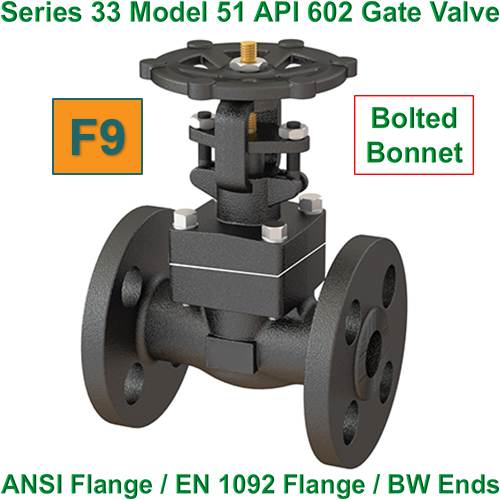
F9 (EN 1.7386) is a high-chromium, molybdenum (9% Cr - 1% Mo) heat-resistant alloy steel. F9 valves are specifically designed for high-temperature, high-pressure environments, exhibiting excellent creep resistance, oxidation resistance, crack resistance, and a low thermal expansion rate.
① F9 valves contain 9% Cr, therefore their resistance to high-temperature H₂S sulfide corrosion is far superior to F5 and F22;
② F9 valves have a high silicon content, enabling the formation of a dense, high-temperature oxide film, making them suitable for high-temperature sulfur environments such as furnace outlets;
F9 valves meet the high-parameter hydrogen-critical conditions of the Nelson curve, exhibiting superior resistance to hydrogen embrittlement and hydrogen-induced cracking compared to F22, making them suitable for high-temperature hydrogenation units.
① The creep strength of F9 valves decreases significantly at temperatures >590℃, and their endurance strength at the same temperature is significantly lower than that of F91 valves, making them unsuitable for supercritical main steam pipelines;
② F9 valves prioritize resistance to sulfidation, while F91 valves prioritize creep strength under pure steam conditions;
① F9 valves can be hardened in air, and the heat-affected zone after welding easily forms hard and brittle martensite;
② Preheating before welding and post-weld PWHT are absolutely essential for F9 valves.
① Heating furnace outlet manifold, oil transfer line;
② High-temperature oil and gas + H₂S sulfidation environment (most typical scenario for F9 valves);
③ When F22/F5 valves are insufficient for sulfidation resistance, F9 valves are selected;
Hydrocracking, hydrodesulfurization high-temperature loops, reactor inlet and outlet bypass lines, heating furnace section (F91 valves are preferred for pure high-temperature main steam operation, F9 valves are not used);
Subcritical boiler superheaters and reheaters;
High-temperature cracked oil and gas, oxidation + sulfidation coexisting conditions.
① Resistance to high-temperature sulfide corrosion;
② High-temperature, high-pressure hydrogen-containing process oil-gas mixtures containing hydrogen sulfide (H₂S);
① Pure steam media with ultra-high creep strength;
② Supercritical thermal power systems.
 Series AZ Pneumatic Piston Actuator
 Series AU Electric Actuator
 Handwheel Operation
 APL 210N Limit Switch Box
 APL 410N Limit Switch Box
 Solenoid Valve
 Solenoid Valve (ATEX)
 Solenoid Valve (ATEX + H2)