
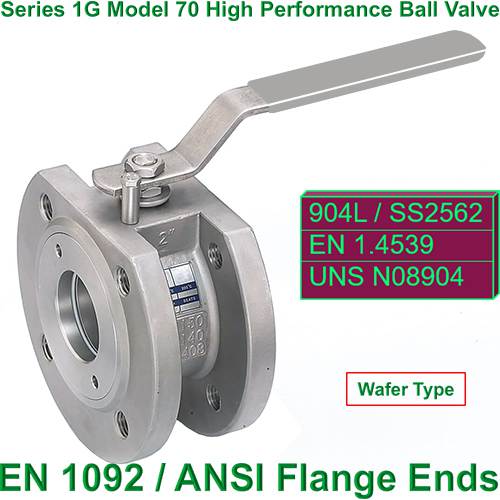
1. What is 904L Stainless Steel?
904L stainless steel (UNS N08904/EN 1.4539) is an ultra-low carbon, high-alloy austenitic stainless steel. Its core advantage is its extremely strong corrosion resistance in harsh environments such as dilute sulfuric acid and chloride-containing media, and it is also easy to process and weld.
2. Freeman Valve's 904L stainless steel ball valve has the following advantages:
2.1 Excellent Corrosion Resistance:
a. Freeman Valve's 904L stainless steel ball valve has high molybdenum (Mo: 4~5%) and copper (Cu: 1~2%) content, which significantly improves their resistance to reducing acids (such as sulfuric acid and phosphoric acid) and halides (such as chloride ions);
b. Freeman Valve's 904L stainless steel ball valve perform excellently in media such as dilute sulfuric acid, boiling phosphoric acid, and organic acids, exhibiting outstanding resistance to pitting and crevice corrosion.
2.2 Excellent resistance to stress corrosion cracking (SCC): Freeman Valve's 904L stainless steel ball valve is suitable for environments containing chloride ions (such as seawater and chloride solutions), exhibiting superior resistance to stress corrosion cracking compared to conventional austenitic stainless steels.
2.3 High-temperature adaptability: Freeman Valve's 904L stainless steel ball valve maintain stability at high temperatures and can withstand short-term environments up to approximately 400°C.
3. The following issues should be noted when using 904L stainless steel ball valve:
3.1 Not suitable for strong oxidizing environments: In strong oxidizing acids such as nitric acid, the corrosion resistance of 904L stainless steel ball valve is actually inferior to that of 304L or 316L ball valve with lower molybdenum content.
3.2 Sensitivity issues: Improper welding or heat treatment can easily lead to carbide precipitation, requiring solution treatment (rapid cooling at 1100~1150°C) to restore performance.
4. Classic Applications of Freeman Valve's 904L Stainless Steel Ball valve:
4.1 Freeman Valve's 904L stainless steel ball valve is widely used in sulfuric acid environments. Examples include: dilute sulfuric acid storage tanks, pipelines, and heat exchangers (especially for sulfuric acid concentrations ≤10%, exhibiting excellent corrosion resistance at temperatures ≤40℃).
4.2 Freeman Valve's 904L stainless steel ball valve is widely used in chloride-containing systems. Examples include: seawater cooling systems, salt chemical evaporators, and chlorination reactor linings.
4.3 Freeman Valve's 904L stainless steel ball valve is widely used in organic acid processing. Examples include: acetic acid and formic acid production equipment, preventing localized corrosion.
4.4 Freeman Valve's 904L stainless steel ball valve is widely used in environmental protection and hydrometallurgical fields. Examples include: flue gas desulfurization (FGD) system components and acidic wastewater treatment equipment.
4.5 Freeman Valve's 904L stainless steel ball valve is widely used in PTA (purified terephthalic acid) production. For example: crystallizers and condensers used in high-temperature acetic acid media.
4.6 Freeman Valve's 904L stainless steel ball valve is widely used in the pharmaceutical industry. For example: reaction vessels and pipelines for high-purity pharmaceuticals (resistant to cleaning agent corrosion).
Differences between 904L and 2205 stainless steel ball valve in resisting chloride ion corrosion
1. Different emphasis on pitting/crevice corrosion resistance:
1.1 The pitting equivalent value (PREN≈33-35) of 2205 ball valve is higher than that of 904L ball valve (PREN≈32-34), and the strengthening effect of nitrogen makes it more resistant to pitting corrosion in high-concentration, high-temperature chloride ion environments (such as high-chlorinated brine in deep well oil production, seawater above 60℃).
1.2 The high nickel + copper content of 904L ball valve results in a passivation film stability far exceeding that of 2205 in chloride-containing reducing media (such as dilute sulfuric acid + chloride ion mixed systems), and avoids the phase imbalance problem of duplex steel. 2. Differences in Stress Corrosion Cracking (SCC) Resistance:
2.1 Stress corrosion cracking under chloride ion conditions is a common failure mode for austenitic stainless steel 2205 ball valve, but the high nickel content of 904L ball valve significantly reduces this susceptibility. 2205 ball valve also exhibit better SCC resistance than ordinary austenitic steels such as 316L, but under the same chloride ion concentration and stress conditions, their long-term stability is slightly lower than that of 904L ball valve.
3. Differences in Process and Operating Condition Matching:
3.1 904L ball valve require no heat treatment after welding and has good low-temperature toughness, making them suitable for polar and marine environments.
3.2 2205 ball valve require controlled heat input during welding to avoid excessive ferrite content, but their high strength (tensile strength ≥620MPa, more than 1.2 times that of 904L ball valve) makes them more suitable for high-pressure + high-chlorine composite operating conditions (such as high-pressure seawater pipelines).
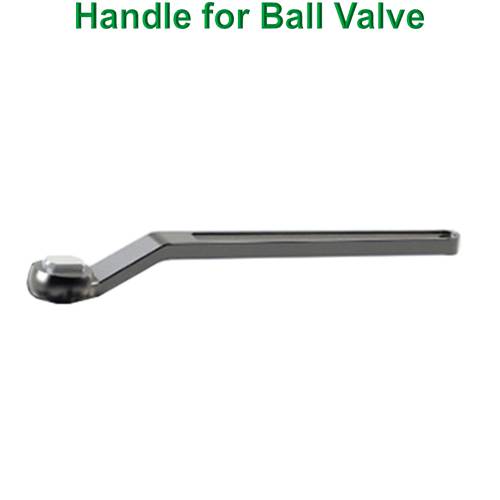 Level Operation
  Series RT Pneumatic Actuator (A)
  Series RT Pneumatic Actuator (M)
  Series RT Pneumatic Actuator (S)
  Series QF Electric Actuator
  Series QU Electric Actuator
  APL 210N Limit Switch Box
  APL 410N Limit Switch Box
  Solenoid Valve
  Solenoid Valve (ATEX)
  Solenoid Valve (ATEX + H2)