
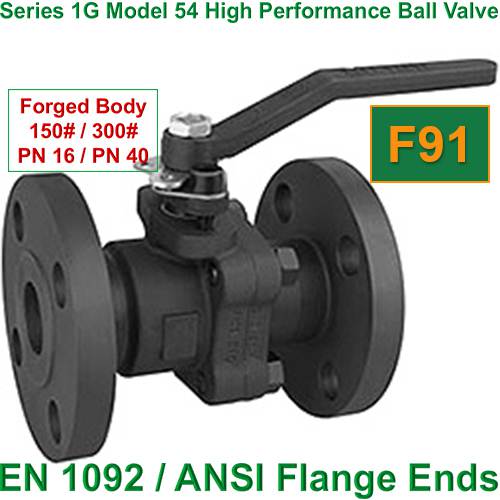
F91 (EN 1.4903) valves are alloy steel valves made of high-temperature resistant, creep-resistant chromium-molybdenum forged steel, containing approximately 9% chromium, 1% molybdenum, and 1% vanadium. These valves can withstand extreme pressures and temperatures up to 600°C to 650°C, making them ideal for high-temperature steam media, such as high-pressure, high-temperature steam pipeline systems, power plants, and long-haul fossil fuel boilers.
The addition of V, Nb, and N elements to form stable carbonitride pinned grain boundaries results in creep strength approximately twice that of F22 and significantly higher than F9. Under the same temperature and pressure, the wall thickness can be reduced, decreasing equipment weight and pipeline load;
Containing 9% Cr, F91 valves form a dense oxide layer, providing superior oxidation resistance in pure steam environments;
F91 valves outperform low-chromium molybdenum steel in high-temperature, high-pressure hydrogen-contaminated conditions, making them ideal for high-temperature hydrogen-contaminated pipelines in oil refining hydrogenation and gasification units;
Their excellent resistance to thermal fatigue makes F91 valves highly suitable for boilers and combined cycle units experiencing frequent start-ups and shutdowns and temperature fluctuations.
F91 valves must be preheated to 205–370℃, and interpass temperature must be controlled; post-weld forced PWHT: narrow window insulation of 730–780℃; the heat treatment range is narrow, too low a temperature will easily cause hardening and embrittlement, too high a temperature will result in loss of creep strength;
F91 valves are only suitable for pure steam and clean hydrogen-containing media; F91 valves are not resistant to chloride ions, sulfides, and acidic media.
① Main steam and high-temperature reheat steam pipelines for supercritical/subcritical and combined cycle power plants;
② Boiler superheaters and reheater headers;
③ Waste incineration and biomass high-temperature boilers;
① High-temperature heating furnace inlets and outlets and high-temperature hydrogen pipelines in hydrogenation units;
② High-temperature and high-pressure process pipelines in coal gasification and syngas units;
① High-temperature and high-pressure steam networks, accumulators, and high-temperature heat exchangers in large-scale combined heat and power plants;
② Molten salt energy storage and high-temperature thermal oil systems.
Suitable for temperatures between 540 and 620°C, where the medium is pure steam or hydrogen-containing, and where lightweight design and creep control are key performance indicators.
① Operating temperatures consistently above 620°C;
② Chlorine-containing, acidic, or high-sulfur corrosive environments.
 Level Operation
 Series RT Pneumatic Actuator (A)
 Series RT Pneumatic Actuator (M)
 Series RT Pneumatic Actuator (S)
 Series QF Electric Actuator
 Series QU Electric Actuator
 APL 210N Limit Switch Box
 APL 410N Limit Switch Box
 Solenoid Valve
 Solenoid Valve (ATEX)
 Solenoid Valve (ATEX + H2)