
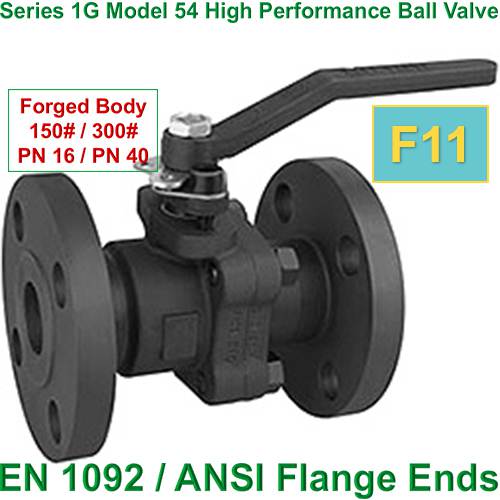
F11 is a low-alloy chromium-molybdenum heat-resistant steel, widely used in boilers, pressure vessels, and piping systems.
F11 valves have low preheating requirements before welding and a wide tolerance for post-weld heat treatment temperature ranges;
Under operating conditions of ≤480℃, F11 valves have creep and endurance strength sufficient for medium-temperature and medium-pressure steam conditions;
F11 valves can be used in hydrogen-rich environments with less stringent temperature and pressure requirements, suitable for medium- and low-temperature hydrogenation pipelines.
When the operating temperature exceeds 480℃, the creep strength of F11 valves will decrease rapidly.
① The corrosion rate of F11 valves to high-temperature H₂S media is significantly higher than that of F22, and far worse than that of F5;
② The corrosion rate of F11 valves to high-temperature oxidizing media is lower than that of F22;
① Under high-pressure, high-temperature hydrogen-contaminated conditions, the risk of hydrogen-induced cracking of F11 valves is higher than that of F22;
② F11 valves cannot be used in harsh hydrogenation main process pipelines.
Bypasses, reheat cold sections, and auxiliary steam pipelines in subcritical units;
Heater outlets, fractionation systems, and secondary pipelines in reforming units with operating temperatures ≤480℃;
Auxiliary pipelines, venting, and heat exchange sub-lines in hydrogenation units;
Process steam systems with operating temperatures between 420-480℃.
① When the design temperature is >480℃, directly upgrade to F22 valves; do not force the use of F11 valves.
② For high-concentration H₂S sulfidation corrosion conditions, F11 valves are insufficiently corrosion-resistant; F5 valves should be selected first.
③ For critical high-temperature, high-pressure hydrogen-related core process pipelines, do not select F11 valves; select F22 valves instead.
Choose F11 valves: Auxiliary systems with operating temperatures ≤480℃;
Choose F22 valves: Main steam systems and main hydrogenation process systems with operating temperatures between 480-540℃.
 Level Operation
 Series RT Pneumatic Actuator (A)
 Series RT Pneumatic Actuator (M)
 Series RT Pneumatic Actuator (S)
 Series QF Electric Actuator
 Series QU Electric Actuator
 APL 210N Limit Switch Box
 APL 410N Limit Switch Box
 Solenoid Valve
 Solenoid Valve (ATEX)
 Solenoid Valve (ATEX + H2)