
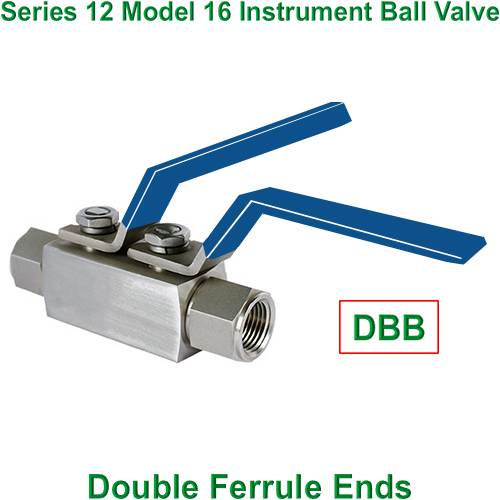
1. About Instrument Ball Valves: Instrument ball valves are small-diameter precision ball valves, characterized by reliable sealing, compact size, rapid opening and closing, and high leakage control. These valves are designed to provide precise flow control, system stability, and sealed connections, playing a crucial role in maintaining operational safety and efficiency. They are primarily used in instrument piping, analytical sampling, and hydraulic/pneumatic pressure measurement circuits.
2. Functions of Instrument Ball Valves: Instrument valves are designed for precise fluid control, ensuring system reliability and stability. By managing pressure and flow direction, these valves prevent leaks and reduce safety risks, especially in systems handling hazardous or high-pressure media. Their role extends beyond fluid control, protecting personnel, equipment, and the environment from potential hazards. Industries such as petrochemicals, pharmaceuticals, semiconductor manufacturing, and clean energy heavily rely on instrument valves in their operations. In these industries, maintaining stringent leakage performance and the ability to manage extreme environments are critical to ensuring safe and efficient processes.
3. Freeman Valve's instrument ball valves have the following significant characteristics:
3.1 Straight-through flow path, large flow capacity: Freeman Valve's instrument ball valves have a high Kv value, low flow resistance, and prevent media accumulation, making them suitable for gases and viscous media; 90° rotation for fast opening and closing, allowing for quick circuit shut-off;
3.2 Low torque, easy operation: Freeman Valve's instrument ball valves have very low torque, allowing for rapid opening and closing and quick circuit shut-off;
3.3 Floating ball for self-tightening seal: Freeman Valve's instrument ball valves primarily use a floating ball structure, where media pressure presses the ball against the outlet valve seat, achieving a self-tightening seal;
3.4 Compact size, light weight, and compact installation: Due to their small size and light weight, Freeman Valve's instrument ball valves can be installed side-by-side on instrument panels and valve racks; they can also be equipped with small pneumatic actuators for remote switching in automatic sampling circuits.
4. Precautions for using instrument ball valves:
4.1 Instrument ball valves cannot be used for long-term throttling; they are only suitable for full open or full close operation.
4.2 For ultra-high temperature/low temperature media, an extended valve shaft is required.
5. Key application areas of Freeman Valve instrument ball valves:
5.1 Freeman Valve instrument ball valves are widely used in the petrochemical industry. For example: ① Instrument pressure lines in process units: shut-off valves before and after pressure transmitters and differential pressure transmitters, ball valves for three-valve manifolds;
② Online sampling circuits: sampling of oil and chemical media, rapid shut-off to prevent sample leakage;
③ Oil and gas wellheads, analysis cabins: sample inlet shut-off valves for chromatographs and online analytical instruments;
④ High-pressure hydraulic/power oil lines.
5.2 Freeman Valve instrument ball valves are widely used in the power industry. For example:
① Instrumentation valves for power plant thermal systems: pressure measuring points, steam sampling devices;
② Steam sampling racks: shut-off ball valves for high-temperature water and steam sampling;
③ Nuclear power plant instrumentation pipelines, using nuclear-grade instrumentation ball valves, radiation-resistant and with high sealing ratings.
5.3 Freeman Valve's instrumentation ball valves are widely used in analytical instruments and laboratory systems. For example:
① Gas circuit shut-off for gas chromatography and online analytical equipment;
② High-purity gas pipelines: nitrogen, hydrogen, argon, high-purity versions with EP electrolytic polishing of the inner surface, low precipitation, preventing sample contamination;
③ Laboratory high-pressure gas circuit panels.
5.4 Freeman Valve's instrumentation ball valves are widely used in hydraulic and power control systems. For example:
① High-pressure shut-off of small circuits in hydraulic stations, hydraulic test benches;
② Pressure measurement pipelines for engineering machinery instruments.
5.5 Freeman Valve's instrumentation ball valves are widely used in coal chemical, polysilicon, and new energy fields. For example:
① High-pressure sampling in coal chemical industry, dealing with corrosive media (including H₂S), using sulfur-resistant materials;
② High-purity special gas pipelines in polycrystalline silicon and lithium battery production, using EP polished instrument ball valves.
5.6 Freeman Valve's instrument ball valves are widely used in marine engineering and offshore platforms. For example: offshore platform instrument valves, resistant to salt spray corrosion, with 316L or Alloy valve bodies, and a ferrule welded structure to prevent external leakage caused by sea wind corrosion.
5.6 Freeman Valve's instrument ball valves are widely used in refrigeration and cryogenic conditions. For example, LNG and liquid nitrogen -196℃ cryogenic instrument ball valves, after cryogenic treatment, are used for instrument pressure testing and sampling in cryogenic storage tanks.