
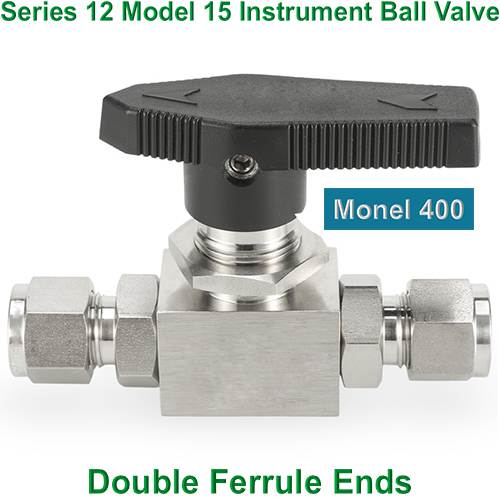
Monel 400 is a solution-treated nickel-copper alloy. Due to its excellent corrosion resistance, high strength, and good durability, it is suitable for a wide temperature range.
a. Monel 400 instrument ball valves manufactured by Freeman Valve are resistant to seawater, salt spray, hydrofluoric acid, fluorine gas, and alkaline solutions, especially superior to stainless steel in reducing media;
b. Monel 400 instrument ball valves manufactured by Freeman Valve have strong resistance to chloride stress corrosion cracking (SCC), making them suitable for environments containing Cl⁻ (such as seawater desalination).
a. Freeman Valve's Monel 400 instrument ball valves are characterized by high strength, good toughness, and high plasticity (maintaining performance even at low temperatures);
b. Freeman Valve's Monel 400 instrument ball valves are suitable for a wide operating temperature range (-200°C to +600°C).
Freeman Valve's Monel 400 instrument ball valves are ideal for high-speed fluids or media containing particles;
Monel 400 instrument ball valves are not resistant to oxidizing acids and corrode rapidly in strong oxidizing media such as nitric acid and concentrated sulfuric acid.
For example: seawater heat exchangers and other equipment resistant to seawater corrosion.
For example: hydrofluoric acid storage tanks, pipelines, etc. (Monel is one of the few metallic materials resistant to HF).
For example: downhole equipment (resistant to H₂S and CO₂ corrosion).
For example: sulfuric acid/hydrochloric acid reactors, distillation columns, condensers (for low to medium concentration, non-oxidizing environments).
Monel 400 (UNS N04400) is a nickel-copper alloy (approximately 67% Ni and 30% Cu). Due to its excellent resistance to seawater corrosion, it is widely used in marine engineering, shipbuilding, and seawater desalination. However, it still has limitations under certain specific conditions. The following is a detailed analysis of its advantages and disadvantages.
a. Freeman Valve's Monel 400 instrument ball valves exhibit extremely low corrosion rates (typically <0.025 mm/year) in normal temperature seawater (pH 7.5-8.4), superior to 304/316 stainless steel (which is prone to pitting corrosion).
b. Freeman Valve's Monel 400 instrument ball valves are resistant to salt spray corrosion and are suitable for marine atmospheric environments (such as offshore platforms and ship deck equipment).
Freeman Valve's Monel 400 instrument ball valves have a high nickel content, giving them excellent resistance to erosion corrosion, making them suitable for high-speed fluid environments.
Due to its high nickel content, Freeman Valve's Monel 400 instrument ball valves are not sensitive to stress corrosion cracking, making them ideal for seawater pipeline systems and heat exchangers (especially in high-temperature seawater conditions).
Freeman Valve's Monel 400 instrument ball valves have a high copper content (up to 30%), giving them antibacterial properties. This effectively reduces the attachment of marine organisms such as barnacles and algae, lowering the risk of microbial corrosion.
Freeman Valve's Monel 400 instrument ball valves maintain their toughness and show no tendency to become embrittled in extremely cold seawater, making them ideal for cryogenic marine equipment.
While Monel 400 instrument ball valves are resistant to erosion corrosion, prolonged high flow rates in seawater containing suspended sand particles (such as in nearshore waters) can accelerate wear (requiring the use of a wear-resistant coating).
a. Pitting: Monel 400 instrument ball valves may experience slight pitting corrosion in stagnant seawater or low-oxygen environments (such as dead zones in pipelines) (but far less than with stainless steel). This can be mitigated by increasing the flow rate or using cathodic protection (such as sacrificial anodes).
b. Crevice Corrosion: Monel 400 instrument ball valves may experience corrosion due to oxygen concentration cells in areas such as connections and gasket gaps (design optimization is needed to avoid crevice corrosion).
In anaerobic seawater (such as in seabed silt areas), sulfate-reducing bacteria (SRB) may produce H₂S, leading to sulfide stress corrosion cracking (SSCC) in Monel 400 instrument ball valves. However, this can be mitigated by cathodic protection (such as zinc anodes).
Monel 400 instrument ball valves are alloy valves with excellent corrosion resistance in seawater environments, especially suitable for flowing seawater, high-temperature seawater, and SCC resistance applications. However, in high-wear, H₂S environments, or budget-constrained situations, alternative solutions (such as titanium alloys or super duplex steel) need to be evaluated.
Monel 400's corrosion resistance mechanism relies on the formation of a stable protective oxide film on a high-nickel matrix under strongly alkaline conditions, preventing alkali embrittlement (caustic SCC).
① At room temperature (25℃), the corrosion rate of Monel 400 instrument ball valves to any concentration of KOH is approximately 0.01 mm/a;
② At temperature between 100 and 110℃, the corrosion rate of Monel 400 instrument ball valves to KOH concentrations of 0-50% is approximately 0.05 mm/a;
③ At temperature between 120 and 150℃, the corrosion rate of Monel 400 instrument ball valves to KOH concentrations of 0-70% is approximately 0.1 mm/a. In this case, a corrosion allowance must be allowed;
④ At temperature >150℃, the corrosion rate of Monel 400 instrument ball valves to KOH concentrations >70% is >0.1 mm/a. In this case, Nickel 200 instrument ball valves should be selected.
Under reducing, deoxygenated hydrofluoric acid conditions, the Monel 400 instrument ball valve forms a dense and stable nickel-copper fluoride protective film on its surface, preventing further dissolution of the substrate.
① At room temperature (25℃), the corrosion rate of Monel 400 instrument ball valves to aqueous hydrofluoric acid of any concentration is approximately 0.02 mm/a;
② At temperatures ≤80℃, the corrosion rate of Monel 400 instrument ball valves to full-concentration aqueous hydrofluoric acid is approximately 0.05 mm/a;
③ At temperatures between 110 and 120℃, the corrosion rate of Monel 400 instrument ball valves to 40-70% concentration aqueous hydrofluoric acid is approximately 0.13 mm/a;
④ At temperatures ≤230℃, the corrosion rate of Monel 400 instrument ball valves to anhydrous hydrofluoric acid is approximately 0.05 mm/a.
Design Acc. to ASME B16.34 (ANSI Standard Monel 400 Ball Valve);
Design Acc. to EN-12516-1/2 (EN Standard Monel 400 Ball Valve, DIN Standard Monel 400 Ball Valve).
Test Acc. to API 598 (ANSI Standard Monel 400 Ball Valve);
Test Acc. to EN 12266-1/2 (EN Standard Monel 400 Ball Valve, DIN Standard Monel 400 Ball Valve).
All Monel 400 Ball Valve surface is finely machined to achieve the required roughness and conforms to standard MSS SP-55.
From DN1/4’’ to 48’’ (ANSI Standard Monel 400 Ball Valve);
From DN8 to DN1200 (EN Standard Monel 400 Ball Valve, DIN Standard Monel 400 Ball Valve).
Face to Face Acc. to ASME B16.10 (ANSI Standard Monel 400 Ball Valve);
Face to Face Acc. to EN 558-1 (EN Standard Monel 400 Ball Valve, DIN Standard Monel 400 Ball Valve).
ANSI Class 150 Monel 400 Ball Valve (ANSI Standard Monel 400 Ball Valve);
ANSI Class 300 Monel 400 Ball Valve (ANSI Standard Monel 400 Ball Valve);
ANSI Class 600 Monel 400 Ball Valve (ANSI Standard Monel 400 Ball Valve);
ANSI Class 800 Monel 400 Ball Valve (ANSI Standard Monel 400 Ball Valve);
ANSI Class 900 Monel 400 Ball Valve (ANSI Standard Monel 400 Ball Valve);
ANSI Class 1500 Monel 400 Ball Valve (ANSI Standard Monel 400 Ball Valve);
ANSI Class 2500 Monel 400 Ball Valve (ANSI Standard Monel 400 Ball Valve);
EN 1092 PN 16 Monel 400 Ball Valve (EN Standard Monel 400 Ball Valve, DIN Standard Monel 400 Ball Valve);
EN 1092 PN 25 Monel 400 Ball Valve (EN Standard Monel 400 Ball Valve, DIN Standard Monel 400 Ball Valve);
EN 1092 PN 40 Monel 400 Ball Valve (EN Standard Monel 400 Ball Valve, DIN Standard Monel 400 Ball Valve);
EN 1092 PN 63 Monel 400 Ball Valve (EN Standard Monel 400 Ball Valve, DIN Standard Monel 400 Ball Valve);
EN 1092 PN 100 Monel 400 Ball Valve (EN Standard Monel 400 Ball Valve, DIN Standard Monel 400 Ball Valve);
EN 1092 PN 160 Monel 400 Ball Valve (EN Standard Monel 400 Ball Valve, DIN Standard Monel 400 Ball Valve);
EN 1092 PN 250 Monel 400 Ball Valve (EN Standard Monel 400 Ball Valve, DIN Standard Monel 400 Ball Valve);
EN 1092 PN 320 Monel 400 Ball Valve (EN Standard Monel 400 Ball Valve, DIN Standard Monel 400 Ball Valve);
EN 1092 PN 400 Monel 400 Ball Valve (EN Standard Monel 400 Ball Valve, DIN Standard Monel 400 Ball Valve).
Please refer to the "Temperature and Pressure Curve of Monel 400 Ball Valve" for temperature and pressure changes.
ANSI Flange Ends Monel 400 Ball Valve;
ANSI Integral Flange Ends Monel 400 Ball Valve;
ANSI Welded Flange Ends Monel 400 Ball Valve;
Butt Weld (ASME B16.25) Ends Monel 400 Ball Valve;
Butt Weld x ANSI Flange Ends Monel 400 Ball Valve;
EN 1092 Flange Ends Monel 400 Ball Valve;
EN 1092 Integral Flange Ends Monel 400 Ball Valve;
EN 1092 Welded Flange Ends Monel 400 Ball Valve;
Butt Weld (EN 12627) Ends Monel 400 Ball Valve;
Butt Weld (ISO 1127) Ends Monel 400 Ball Valve;
Butt Weld x EN 1092 Flange Ends Monel 400 Ball Valve;
Male NPT (ASME B1.20.1) Ends Monel 400 Ball Valve;
Male BSPP (ISO 228-1) Ends Monel 400 Ball Valve;
Male BSPT (ISO 7-1) Ends Monel 400 Ball Valve;
Male NPT x Female NPT Ends Monel 400 Ball Valve;
Male BSPP x Female BSPP Ends Monel 400 Ball Valve;
Male BSPT x Female BSPT Ends Monel 400 Ball Valve;
Male NPT x Long Butt Weld (+100 mm) Ends Monel 400 Ball Valve;
Male BSPP x Long Butt Weld (+100 mm) Ends Monel 400 Ball Valve;
Male BSPT x Long Butt Weld (+100 mm) Ends Monel 400 Ball Valve;
Female NPT (ASME B1.20.1) Ends Monel 400 Ball Valve;
Female BSPP (ISO 228-1) Ends Monel 400 Ball Valve;
Female BSPT (ISO 7-1) Ends Monel 400 Ball Valve;
Socket Weld (ASME B16.11) Ends Monel 400 Ball Valve;
Socket Weld (EN 12760) Ends Monel 400 Ball Valve;
Female NPT x Socket Weld Ends Monel 400 Ball Valve;
Female BSPP x Socket Weld Ends Monel 400 Ball Valve;
Female BSPT x Socket Weld Ends Monel 400 Ball Valve;
Butt Weld (ASME B16.25) Ends Monel 400 Ball Valve;
Butt Weld (EN 12627) Ends Monel 400 Ball Valve;
Female NPT x Butt Weld Ends Monel 400 Ball Valve;
Female BSPP x Butt Weld Ends Monel 400 Ball Valve;
Female BSPT x Butt Weld Ends Monel 400 Ball Valve;
Female NPT x Long Butt Weld (+100 mm) Ends Monel 400 Ball Valve;
Female BSPP x Long Butt Weld (+100 mm) Ends Monel 400 Ball Valve;
Female BSPT x Long Butt Weld (+100 mm) Ends Monel 400 Ball Valve;
Long Butt Weld (+100 mm Weld Stub) Ends Monel 400 Ball Valve.
CE Marking is Available to Monel 400 Ball Valve with a Diameter of DN32 or Larger.
For the Chemical Composition of Monel 400 Ball Valve, please refer to EN 10204 Type 3.1 certificate.
For the Mechanical Properties of Monel 400 Ball Valve, please refer to EN 10204 Type 3.1 certificate.
All Monel 400 Ball Valve will be delivered with EN 10204 Type 3.1 Certificate.
MSS SP-55 Certified of Monel 400 Ball Valve;
NACE MR 0175 Certified of Monel 400 Ball Valve
API 607 Fire Safe Certified of Monel 400 Ball Valve;
ISO 9001 Certified of Monel 400 Ball Valve;
PED Certified of Monel 400 Ball Valve.
NACE MR0175 is available upon request of Monel 400 Ball Valve;
ATEX is available upon request of Monel 400 Ball Valve;
TA-LUFT is available upon request of Monel 400 Ball Valve;
SIL is available upon request of Monel 400 Ball Valve;
Degreasing is available upon request of Monel 400 Ball Valve;
Fire Safe is available upon request of Monel 400 Ball Valve;
Stem Extension is available upon request of Monel 400 Ball Valve;
Double Block and Bleed is available upon request of Monel 400 Ball Valve.