
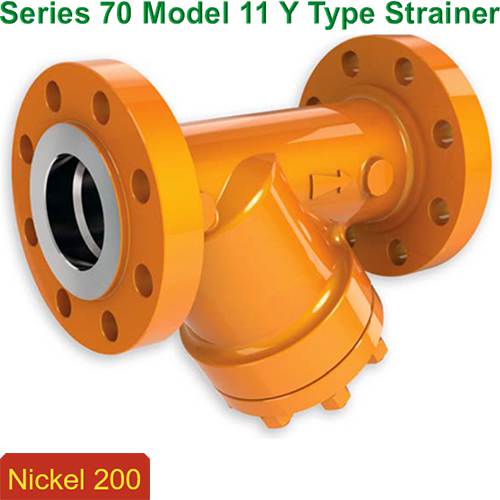
Nickel 200 Y-type strainers are made of a nickel alloy with a nickel content of at least 99.0%, providing extremely high resistance to caustic alkalis, neutral salt solutions, alkaline salt solutions, and dry fluoride.
2.1 Nickel 200 Y-type strainers exhibit excellent corrosion resistance across the entire concentration range of caustic alkaline media such as NaOH and KOH, from dilute to concentrated and even molten alkalis. A stable, insoluble nickel hydroxide protective film forms on the surface in strongly alkaline environments, resulting in a low corrosion rate.
2.2 Nickel 200 Y-type strainers are less prone to alkali stress corrosion cracking in caustic alkaline environments.
2.3 Nickel 200 Y-type strainers experience only slight corrosion in distilled water, fresh water, and neutral dilute salt solutions at room temperature with low chlorine and low oxygen levels.
2.4 In degassed reducing media, Nickel 200 Y-type strainers exhibit a low corrosion rate due to the lack of an oxidant to sustain the electrochemical reaction; examples include degassed dilute sulfuric acid, degassed dilute hydrochloric acid, and degassed organic acids.
2.5 Nickel 200 Y-type strainers exhibit excellent corrosion resistance in dry halogen environments, forming a stable nickel halide protective film. Examples include dry fluorine gas (F₂), dry chlorine gas (Cl₂), dry bromine gas (Br₂), and dry iodine gas (I₂).
3.1 Nickel 200 Y-type strainers have a high carbon content, and their long-term service temperature should not exceed 315℃. For high-temperature concentrated alkali and molten alkali applications above this temperature, Nickel 201 should be selected to avoid graphitization and intergranular embrittlement;
3.2 Nickel 200 Y-type strainers are not resistant to oxidizing media.
① Nickel 200 Y-type strainers are severely corroded by concentrated nitric acid, strong oxidizing acids, chlorides containing oxidants, and wet chlorine gas;
② The corrosion rate of Nickel 200 Y-type strainers increases significantly when exposed to aerated oxidizing acids.
① Caustic soda evaporators, concentrators, alkali storage tanks, alkali delivery pipelines, heat exchangers, reaction vessels, etc. (≤315℃);
② Molten alkali containers (≤315℃);
③ Anhydrous fluorination and halogen drying process equipment (drying Cl₂, anhydrous HF);
④ Degassing and reducing organic acids, high-purity chemical intermediate containers;
⑤ Saponification and phenol production equipment;
① Alkaline batteries (nickel-cadmium batteries): electrodes, current collectors, KOH electrolyte contact parts;
② Electroplating industry: nickel plating anodes, plating tank internal components;
③ Vacuum devices: vacuum tube components, vacuum chambers, evaporation sources; low vapor pressure, low outgassing, suitable for high-purity vacuum environments;
① Food: Oil, dairy, and juice processing equipment, heat exchangers, and agitators; resistant to organic acids and neutral media, less prone to metal ion leaching affecting color/flavor;
② Pharmaceutical: Raw material reaction tanks, storage pipelines, and clean process equipment for high-purity intermediates;
③ Synthetic fiber (viscose rayon): Spinning heads and spinnerets to prevent fiber discoloration and metal contamination;
① Halogen drying processes: Equipment for drying chlorine and anhydrous fluoride (strictly anhydrous prerequisite);
② Degassed freshwater, distilled water, and low-chlorine neutral dilute salt systems: High-purity water and some desalination unit components (not suitable for high-chlorine, oxygen-enriched seawater).
Design Standard of Nickel 200 Y Type Strainer:
Design Acc. to ASME B16.34 (ANSI Standard Nickel 200 Y Type Strainer);
Design Acc. to EN-12516-1/2 (EN Standard Nickel 200 Y Type Strainer, DIN Standard Nickel 200 Y Type Strainer).
Test Standard of Nickel 200 Y Type Strainer:
Test Acc. to API 598 (ANSI Standard Nickel 200 Y Type Strainer);
Test Acc. to EN 12266-1/2 (EN Standard Nickel 200 Y Type Strainer, DIN Standard Nickel 200 Y Type Strainer).
Surface Finishing of Nickel 200 Y Type Strainer:
All Nickel 200 Y Type Strainer surface is finely machined to achieve the required roughness and conforms to standard MSS SP-110.
Size of Nickel 200 Y Type Strainer:
From DN1/4’’ to 48’’ (ANSI Standard Nickel 200 Y Type Strainer);
From DN8 to DN1200 (EN Standard Nickel 200 Y Type Strainer, DIN Standard Nickel 200 Y Type Strainer).
Face to Face of Nickel 200 Y Type Strainer:
Face to Face Acc. to ASME B16.10 (ANSI Standard Nickel 200 Y Type Strainer);
Face to Face Acc. to EN 558-1 (EN Standard Nickel 200 Y Type Strainer, DIN Standard Nickel 200 Y Type Strainer).
Pressure Rating of Nickel 200 Y Type Strainer:
ANSI Class 150 Nickel 200 Y Type Strainer (ANSI Standard Nickel 200 Y Type Strainer);
ANSI Class 300 Nickel 200 Y Type Strainer (ANSI Standard Nickel 200 Y Type Strainer);
ANSI Class 600 Nickel 200 Y Type Strainer (ANSI Standard Nickel 200 Y Type Strainer);
ANSI Class 800 Nickel 200 Y Type Strainer (ANSI Standard Nickel 200 Y Type Strainer);
ANSI Class 900 Nickel 200 Y Type Strainer (ANSI Standard Nickel 200 Y Type Strainer);
ANSI Class 1500 Nickel 200 Y Type Strainer (ANSI Standard Nickel 200 Y Type Strainer);
ANSI Class 2500 Nickel 200 Y Type Strainer (ANSI Standard Nickel 200 Y Type Strainer);
EN 1092 PN 16 Nickel 200 Y Type Strainer (EN Standard Nickel 200 Y Type Strainer, DIN Standard Nickel 200 Y Type Strainer);
EN 1092 PN 25 Nickel 200 Y Type Strainer (EN Standard Nickel 200 Y Type Strainer, DIN Standard Nickel 200 Y Type Strainer);
EN 1092 PN 40 Nickel 200 Y Type Strainer (EN Standard Nickel 200 Y Type Strainer, DIN Standard Nickel 200 Y Type Strainer);
EN 1092 PN 63 Nickel 200 Y Type Strainer (EN Standard Nickel 200 Y Type Strainer, DIN Standard Nickel 200 Y Type Strainer);
EN 1092 PN 100 Nickel 200 Y Type Strainer (EN Standard Nickel 200 Y Type Strainer, DIN Standard Nickel 200 Y Type Strainer);
EN 1092 PN 160 Nickel 200 Y Type Strainer (EN Standard Nickel 200 Y Type Strainer, DIN Standard Nickel 200 Y Type Strainer);
EN 1092 PN 250 Nickel 200 Y Type Strainer (EN Standard Nickel 200 Y Type Strainer, DIN Standard Nickel 200 Y Type Strainer);
EN 1092 PN 320 Nickel 200 Y Type Strainer (EN Standard Nickel 200 Y Type Strainer, DIN Standard Nickel 200 Y Type Strainer);
EN 1092 PN 400 Nickel 200 Y Type Strainer (EN Standard Nickel 200 Y Type Strainer, DIN Standard Nickel 200 Y Type Strainer).
Working Temperature of Nickel 200 Y Type Strainer:
Please refer to the "Temperature and Pressure Curve of Nickel 200 Y Type Strainer" for temperature and pressure changes.
Ends Connection of Nickel 200 Y Type Strainer:
ANSI Flange Ends Nickel 200 Y Type Strainer;
ANSI Integral Flange Ends Nickel 200 Y Type Strainer;
ANSI Welded Flange Ends Nickel 200 Y Type Strainer;
Butt Weld (ASME B16.25) Ends Nickel 200 Y Type Strainer;
Butt Weld x ANSI Flange Ends Nickel 200 Y Type Strainer;
EN 1092 Flange Ends Nickel 200 Y Type Strainer;
EN 1092 Integral Flange Ends Nickel 200 Y Type Strainer;
EN 1092 Welded Flange Ends Nickel 200 Y Type Strainer;
Butt Weld (EN 12627) Ends Nickel 200 Y Type Strainer;
Butt Weld (ISO 1127) Ends Nickel 200 Y Type Strainer;
Butt Weld x EN 1092 Flange Ends Nickel 200 Y Type Strainer;
Male NPT (ASME B1.20.1) Ends Nickel 200 Y Type Strainer;
Male BSPP (ISO 228-1) Ends Nickel 200 Y Type Strainer;
Male BSPT (ISO 7-1) Ends Nickel 200 Y Type Strainer;
Male NPT x Female NPT Ends Nickel 200 Y Type Strainer;
Male BSPP x Female BSPP Ends Nickel 200 Y Type Strainer;
Male BSPT x Female BSPT Ends Nickel 200 Y Type Strainer;
Male NPT x Long Butt Weld (+100 mm) Ends Nickel 200 Y Type Strainer;
Male BSPP x Long Butt Weld (+100 mm) Ends Nickel 200 Y Type Strainer;
Male BSPT x Long Butt Weld (+100 mm) Ends Nickel 200 Y Type Strainer;
Female NPT (ASME B1.20.1) Ends Nickel 200 Y Type Strainer;
Female BSPP (ISO 228-1) Ends Nickel 200 Y Type Strainer;
Female BSPT (ISO 7-1) Ends Nickel 200 Y Type Strainer;
Socket Weld (ASME B16.11) Ends Nickel 200 Y Type Strainer;
Socket Weld (EN 12760) Ends Nickel 200 Y Type Strainer;
Female NPT x Socket Weld Ends Nickel 200 Y Type Strainer;
Female BSPP x Socket Weld Ends Nickel 200 Y Type Strainer;
Female BSPT x Socket Weld Ends Nickel 200 Y Type Strainer;
Butt Weld (ASME B16.25) Ends Nickel 200 Y Type Strainer;
Butt Weld (EN 12627) Ends Nickel 200 Y Type Strainer;
Female NPT x Butt Weld Ends Nickel 200 Y Type Strainer;
Female BSPP x Butt Weld Ends Nickel 200 Y Type Strainer;
Female BSPT x Butt Weld Ends Nickel 200 Y Type Strainer;
Female NPT x Long Butt Weld (+100 mm) Ends Nickel 200 Y Type Strainer;
Female BSPP x Long Butt Weld (+100 mm) Ends Nickel 200 Y Type Strainer;
Female BSPT x Long Butt Weld (+100 mm) Ends Nickel 200 Y Type Strainer;
Long Butt Weld (+100 mm Weld Stub) Ends Nickel 200 Y Type Strainer.
CE Marking of Nickel 200 Y Type Strainer:
CE Marking is Available to Nickel 200 Y Type Strainer with a Diameter of DN32 or Larger.
Chemical Composition of Nickel 200 Y Type Strainer:
For the Chemical Composition of Nickel 200 Y Type Strainer, please refer to EN 10204 Type 3.1 certificate.
Mechanical Properties of Nickel 200 Y Type Strainer:
For the Mechanical Properties of Nickel 200 Y Type Strainer, please refer to EN 10204 Type 3.1 certificate.
Certificate of Nickel 200 Y Type Strainer:
All Nickel 200 Y Type Strainer will be delivered with EN 10204 Type 3.1 Certificate.
Approvals of Nickel 200 Y Type Strainer:
MSS SP-110 Certified of Nickel 200 Y Type Strainer;
NACE MR 0175 Certified of Nickel 200 Y Type Strainer
API 607 Fire Safe Certified of Nickel 200 Y Type Strainer;
ISO 9001 Certified of Nickel 200 Y Type Strainer;
PED Certified of Nickel 200 Y Type Strainer.
Available Upon Request of Nickel 200 Y Type Strainer:
NACE MR0175 is available upon request of Nickel 200 Y Type Strainer;
ATEX is available upon request of Nickel 200 Y Type Strainer;
TA-LUFT is available upon request of Nickel 200 Y Type Strainer;
SIL is available upon request of Nickel 200 Y Type Strainer;
Degreasing is available upon request of Nickel 200 Y Type Strainer;
Fire Safe is available upon request of Nickel 200 Y Type Strainer;
Stem Extension is available upon request of Nickel 200 Y Type Strainer;
Double Block and Bleed is available upon request of Nickel 200 Y Type Strainer.