
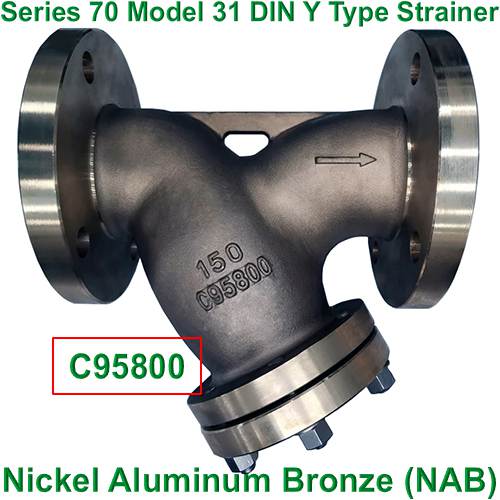
The C95800 Y-type strainers is made of a high-strength nickel-aluminum bronze casting alloy. It is renowned for its excellent seawater corrosion resistance, high load capacity, and resistance to cavitation and wear.
Freeman Valve's C95800 Y-type strainers exhibits exceptional resistance to seawater and chlorinated fluids, making it particularly suitable for marine environments.
Freeman Valve's C95800 Y-type strainers is resistant to cavitation and erosion corrosion, making it suitable for high-velocity media.
Freeman Valve's C95800 Y-type strainers boasts high tensile strength (up to 620 MPa and above) and a hardness exceeding HB 200, making it suitable for high-load, high-wear conditions. Furthermore, it exhibits excellent fatigue resistance, making it suitable for dynamically loaded components.
When used in marine components, Freeman Valve's C95800 Y-type strainers resists marine organism adhesion, reducing maintenance requirements.
3.1 C95800 Y-type strainers are not suitable for operating conditions exceeding 260℃. This is because the strength and corrosion resistance of C95800 Y-type strainers decrease significantly at high temperatures.
3.2 C95800 Y-type strainers are not suitable for strong acids, oxidizing media, or ammonia-containing media (as they are prone to stress corrosion cracking).
3.3 C95800 Y-type strainers are not suitable for polluted seawater. Localized corrosion may occur under low-velocity sediment conditions.
The corrosion resistance of C95800 Y-type strainers mainly relies on the dense oxide film (Al₂O₃ + Cu₂O) formed on its surface, which remains stable even in acidic environments.
Good corrosion resistance (≤10% concentration, room temperature), superior to ordinary bronze; corrosion rate accelerates at high concentrations or high temperatures. However, factors such as temperature, concentration, and oxidizing properties (e.g., air circulation accelerates corrosion) need to be considered.
Moderate corrosion resistance (especially at >5% concentration or high temperatures); Cl⁻ will damage the passivation film, but better than 304 stainless steel. However, factors such as Cl⁻ concentration, pH value, and flow rate (erosion corrosion) need to be considered.
Excellent performance, suitable for low to medium concentration phosphoric acid environments. However, factors such as impurities need to be considered (e.g., fluorides can exacerbate corrosion);
Not corrosion-resistant (strong oxidizing acids damage the Cu-Al film), only suitable for very low concentrations. Concentration needs to be monitored; rapid corrosion occurs when the concentration > 5%;
Good corrosion resistance, suitable for food/chemical equipment. However, key influencing factors such as temperature and oxygen content need to be considered.
The corrosion resistance of C95800 Y-type strainers in acidic media stems from its Al-Ni synergistic passivation effect, making it particularly suitable for low-concentration non-oxidizing acids (such as H₂SO₄, H₃PO₄) and weakly acidic environments containing Cl⁻, but strong oxidizing acids must be avoided. In acidic conditions in chemical, marine, and other fields, its comprehensive performance (corrosion resistance + wear resistance + strength) makes it a cost-effective choice, but nickel-based alloys or titanium materials should be considered for extreme conditions
Design Standard of Nickel Aluminum Bronze C95800 Y Type Strainer:
Design Acc. to ASME B16.34 (ANSI Standard Nickel Aluminum Bronze C95800 Y Type Strainer);
Design Acc. to EN-12516-1/2 (EN Standard Nickel Aluminum Bronze C95800 Y Type Strainer, DIN Standard Nickel Aluminum Bronze C95800 Y Type Strainer).
Test Standard of Nickel Aluminum Bronze C95800 Y Type Strainer:
Test Acc. to API 598 (ANSI Standard Nickel Aluminum Bronze C95800 Y Type Strainer);
Test Acc. to EN 12266-1/2 (EN Standard Nickel Aluminum Bronze C95800 Y Type Strainer, DIN Standard Nickel Aluminum Bronze C95800 Y Type Strainer).
Surface Finishing of Nickel Aluminum Bronze C95800 Y Type Strainer:
All Nickel Aluminum Bronze C95800 Y Type Strainer surface is finely machined to achieve the required roughness and conforms to standard MSS SP-110.
Size of Nickel Aluminum Bronze C95800 Y Type Strainer:
From DN1/4’’ to 48’’ (ANSI Standard Nickel Aluminum Bronze C95800 Y Type Strainer);
From DN8 to DN1200 (EN Standard Nickel Aluminum Bronze C95800 Y Type Strainer, DIN Standard Nickel Aluminum Bronze C95800 Y Type Strainer).
Face to Face of Nickel Aluminum Bronze C95800 Y Type Strainer:
Face to Face Acc. to ASME B16.10 (ANSI Standard Nickel Aluminum Bronze C95800 Y Type Strainer);
Face to Face Acc. to EN 558-1 (EN Standard Nickel Aluminum Bronze C95800 Y Type Strainer, DIN Standard Nickel Aluminum Bronze C95800 Y Type Strainer).
Pressure Rating of Nickel Aluminum Bronze C95800 Y Type Strainer:
ANSI Class 150 Nickel Aluminum Bronze C95800 Y Type Strainer (ANSI Standard Nickel Aluminum Bronze C95800 Y Type Strainer);
ANSI Class 300 Nickel Aluminum Bronze C95800 Y Type Strainer (ANSI Standard Nickel Aluminum Bronze C95800 Y Type Strainer);
ANSI Class 600 Nickel Aluminum Bronze C95800 Y Type Strainer (ANSI Standard Nickel Aluminum Bronze C95800 Y Type Strainer);
ANSI Class 800 Nickel Aluminum Bronze C95800 Y Type Strainer (ANSI Standard Nickel Aluminum Bronze C95800 Y Type Strainer);
ANSI Class 900 Nickel Aluminum Bronze C95800 Y Type Strainer (ANSI Standard Nickel Aluminum Bronze C95800 Y Type Strainer);
ANSI Class 1500 Nickel Aluminum Bronze C95800 Y Type Strainer (ANSI Standard Nickel Aluminum Bronze C95800 Y Type Strainer);
ANSI Class 2500 Nickel Aluminum Bronze C95800 Y Type Strainer (ANSI Standard Nickel Aluminum Bronze C95800 Y Type Strainer);
EN 1092 PN 16 Nickel Aluminum Bronze C95800 Y Type Strainer (EN Standard Nickel Aluminum Bronze C95800 Y Type Strainer, DIN Standard Nickel Aluminum Bronze C95800 Y Type Strainer);
EN 1092 PN 25 Nickel Aluminum Bronze C95800 Y Type Strainer (EN Standard Nickel Aluminum Bronze C95800 Y Type Strainer, DIN Standard Nickel Aluminum Bronze C95800 Y Type Strainer);
EN 1092 PN 40 Nickel Aluminum Bronze C95800 Y Type Strainer (EN Standard Nickel Aluminum Bronze C95800 Y Type Strainer, DIN Standard Nickel Aluminum Bronze C95800 Y Type Strainer);
EN 1092 PN 63 Nickel Aluminum Bronze C95800 Y Type Strainer (EN Standard Nickel Aluminum Bronze C95800 Y Type Strainer, DIN Standard Nickel Aluminum Bronze C95800 Y Type Strainer);
EN 1092 PN 100 Nickel Aluminum Bronze C95800 Y Type Strainer (EN Standard Nickel Aluminum Bronze C95800 Y Type Strainer, DIN Standard Nickel Aluminum Bronze C95800 Y Type Strainer);
EN 1092 PN 160 Nickel Aluminum Bronze C95800 Y Type Strainer (EN Standard Nickel Aluminum Bronze C95800 Y Type Strainer, DIN Standard Nickel Aluminum Bronze C95800 Y Type Strainer);
EN 1092 PN 250 Nickel Aluminum Bronze C95800 Y Type Strainer (EN Standard Nickel Aluminum Bronze C95800 Y Type Strainer, DIN Standard Nickel Aluminum Bronze C95800 Y Type Strainer);
EN 1092 PN 320 Nickel Aluminum Bronze C95800 Y Type Strainer (EN Standard Nickel Aluminum Bronze C95800 Y Type Strainer, DIN Standard Nickel Aluminum Bronze C95800 Y Type Strainer);
EN 1092 PN 400 Nickel Aluminum Bronze C95800 Y Type Strainer (EN Standard Nickel Aluminum Bronze C95800 Y Type Strainer, DIN Standard Nickel Aluminum Bronze C95800 Y Type Strainer).
Working Temperature of Nickel Aluminum Bronze C95800 Y Type Strainer:
Please refer to the "Temperature and Pressure Curve of Nickel Aluminum Bronze C95800 Y Type Strainer" for temperature and pressure changes.
Ends Connection of Nickel Aluminum Bronze C95800 Y Type Strainer:
ANSI Flange Ends Nickel Aluminum Bronze C95800 Y Type Strainer;
ANSI Integral Flange Ends Nickel Aluminum Bronze C95800 Y Type Strainer;
ANSI Welded Flange Ends Nickel Aluminum Bronze C95800 Y Type Strainer;
Butt Weld (ASME B16.25) Ends Nickel Aluminum Bronze C95800 Y Type Strainer;
Butt Weld x ANSI Flange Ends Nickel Aluminum Bronze C95800 Y Type Strainer;
EN 1092 Flange Ends Nickel Aluminum Bronze C95800 Y Type Strainer;
EN 1092 Integral Flange Ends Nickel Aluminum Bronze C95800 Y Type Strainer;
EN 1092 Welded Flange Ends Nickel Aluminum Bronze C95800 Y Type Strainer;
Butt Weld (EN 12627) Ends Nickel Aluminum Bronze C95800 Y Type Strainer;
Butt Weld (ISO 1127) Ends Nickel Aluminum Bronze C95800 Y Type Strainer;
Butt Weld x EN 1092 Flange Ends Nickel Aluminum Bronze C95800 Y Type Strainer;
Male NPT (ASME B1.20.1) Ends Nickel Aluminum Bronze C95800 Y Type Strainer;
Male BSPP (ISO 228-1) Ends Nickel Aluminum Bronze C95800 Y Type Strainer;
Male BSPT (ISO 7-1) Ends Nickel Aluminum Bronze C95800 Y Type Strainer;
Male NPT x Female NPT Ends Nickel Aluminum Bronze C95800 Y Type Strainer;
Male BSPP x Female BSPP Ends Nickel Aluminum Bronze C95800 Y Type Strainer;
Male BSPT x Female BSPT Ends Nickel Aluminum Bronze C95800 Y Type Strainer;
Male NPT x Long Butt Weld (+100 mm) Ends Nickel Aluminum Bronze C95800 Y Type Strainer;
Male BSPP x Long Butt Weld (+100 mm) Ends Nickel Aluminum Bronze C95800 Y Type Strainer;
Male BSPT x Long Butt Weld (+100 mm) Ends Nickel Aluminum Bronze C95800 Y Type Strainer;
Female NPT (ASME B1.20.1) Ends Nickel Aluminum Bronze C95800 Y Type Strainer;
Female BSPP (ISO 228-1) Ends Nickel Aluminum Bronze C95800 Y Type Strainer;
Female BSPT (ISO 7-1) Ends Nickel Aluminum Bronze C95800 Y Type Strainer;
Socket Weld (ASME B16.11) Ends Nickel Aluminum Bronze C95800 Y Type Strainer;
Socket Weld (EN 12760) Ends Nickel Aluminum Bronze C95800 Y Type Strainer;
Female NPT x Socket Weld Ends Nickel Aluminum Bronze C95800 Y Type Strainer;
Female BSPP x Socket Weld Ends Nickel Aluminum Bronze C95800 Y Type Strainer;
Female BSPT x Socket Weld Ends Nickel Aluminum Bronze C95800 Y Type Strainer;
Butt Weld (ASME B16.25) Ends Nickel Aluminum Bronze C95800 Y Type Strainer;
Butt Weld (EN 12627) Ends Nickel Aluminum Bronze C95800 Y Type Strainer;
Female NPT x Butt Weld Ends Nickel Aluminum Bronze C95800 Y Type Strainer;
Female BSPP x Butt Weld Ends Nickel Aluminum Bronze C95800 Y Type Strainer;
Female BSPT x Butt Weld Ends Nickel Aluminum Bronze C95800 Y Type Strainer;
Female NPT x Long Butt Weld (+100 mm) Ends Nickel Aluminum Bronze C95800 Y Type Strainer;
Female BSPP x Long Butt Weld (+100 mm) Ends Nickel Aluminum Bronze C95800 Y Type Strainer;
Female BSPT x Long Butt Weld (+100 mm) Ends Nickel Aluminum Bronze C95800 Y Type Strainer;
Long Butt Weld (+100 mm Weld Stub) Ends Nickel Aluminum Bronze C95800 Y Type Strainer.
CE Marking of Nickel Aluminum Bronze C95800 Y Type Strainer:
CE Marking is Available to Nickel Aluminum Bronze C95800 Y Type Strainer with a Diameter of DN32 or Larger.
Chemical Composition of Nickel Aluminum Bronze C95800 Y Type Strainer:
For the Chemical Composition of Nickel Aluminum Bronze C95800 Y Type Strainer, please refer to EN 10204 Type 3.1 certificate.
Mechanical Properties of Nickel Aluminum Bronze C95800 Y Type Strainer:
For the Mechanical Properties of Nickel Aluminum Bronze C95800 Y Type Strainer, please refer to EN 10204 Type 3.1 certificate.
Certificate of Nickel Aluminum Bronze C95800 Y Type Strainer:
All Nickel Aluminum Bronze C95800 Y Type Strainer will be delivered with EN 10204 Type 3.1 Certificate.
Approvals of Nickel Aluminum Bronze C95800 Y Type Strainer:
MSS SP-110 Certified of Nickel Aluminum Bronze C95800 Y Type Strainer;
NACE MR 0175 Certified of Nickel Aluminum Bronze C95800 Y Type Strainer
API 607 Fire Safe Certified of Nickel Aluminum Bronze C95800 Y Type Strainer;
ISO 9001 Certified of Nickel Aluminum Bronze C95800 Y Type Strainer;
PED Certified of Nickel Aluminum Bronze C95800 Y Type Strainer.
Available Upon Request of Nickel Aluminum Bronze C95800 Y Type Strainer:
NACE MR0175 is available upon request of Nickel Aluminum Bronze C95800 Y Type Strainer;
ATEX is available upon request of Nickel Aluminum Bronze C95800 Y Type Strainer;
TA-LUFT is available upon request of Nickel Aluminum Bronze C95800 Y Type Strainer;
SIL is available upon request of Nickel Aluminum Bronze C95800 Y Type Strainer;
Degreasing is available upon request of Nickel Aluminum Bronze C95800 Y Type Strainer;
Fire Safe is available upon request of Nickel Aluminum Bronze C95800 Y Type Strainer;
Stem Extension is available upon request of Nickel Aluminum Bronze C95800 Y Type Strainer;
Double Block and Bleed is available upon request of Nickel Aluminum Bronze C95800 Y Type Strainer.